


Automatic vs Semi-Automatic Shrink Wrappers: Which Is Right for Your Business?
Choosing between an automatic and semi-automatic shrink wrapping machine is an important decision for manufacturers looking to improve packaging efficiency, reduce labour costs and maintain consistent packaging quality. Both machine types use shrink film and heat to create secure, tamper-evident packaging, but they differ significantly in terms of automation, production speed and operator involvement.
Understanding the differences can help businesses select the most suitable solution for their production requirements and future growth plans.
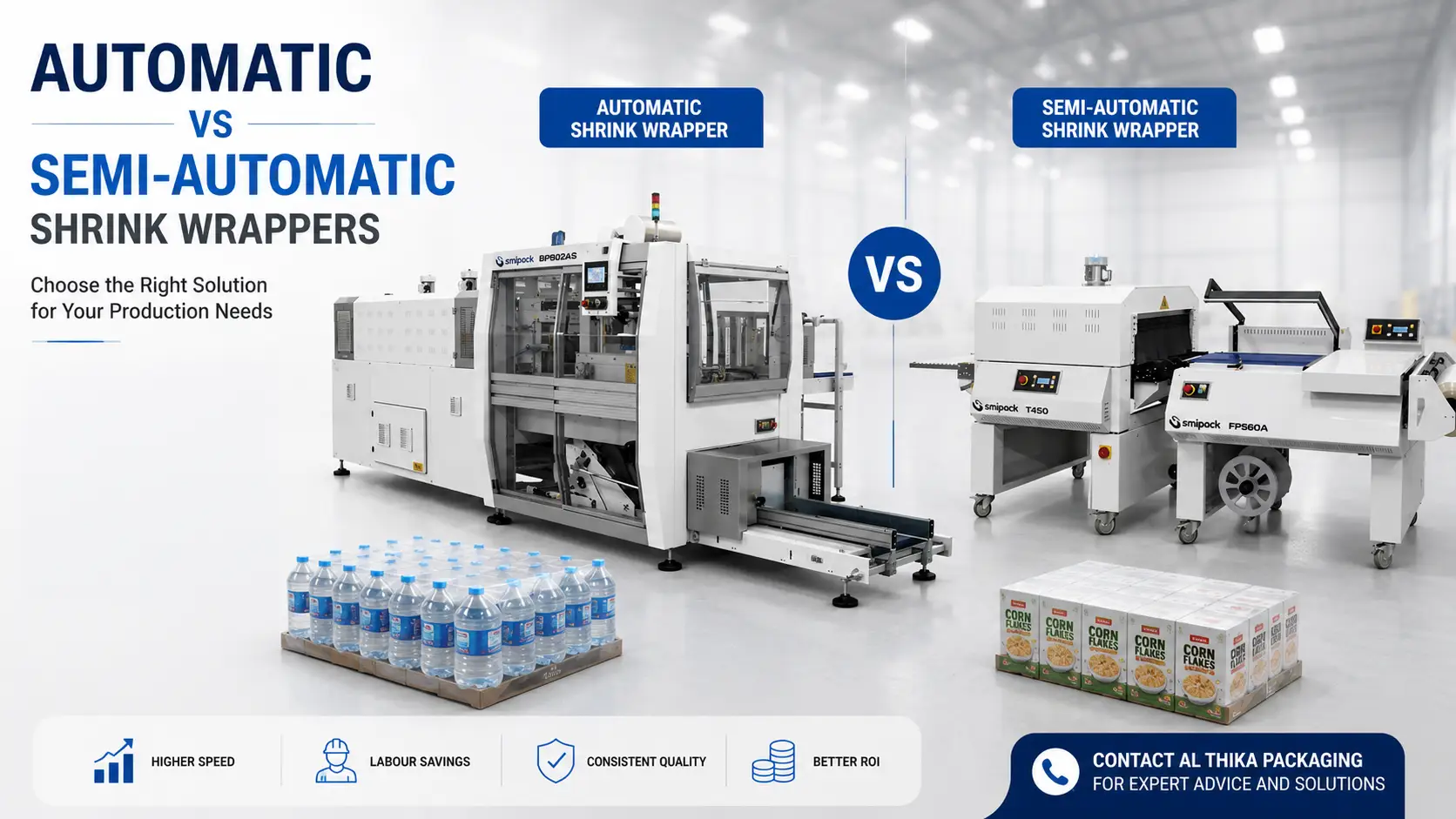
What Is a Semi-Automatic Shrink Wrapping Machine?
A semi-automatic shrink wrapping machine requires an operator to manually load or position products before the machine performs the sealing and shrinking process.
Typically, the operator places the product into/onto the machine, aligns the product grouping or collation as required, then initiates the sealing cycle. The wrapped products are then transferred automatically on a conveyor into the shrink tunnel. Semi-automatic systems offer a balance between productivity and affordability, making them suitable for small to medium production environments.
Benefits of Semi-Automatic Shrink Wrappers
- Lower initial investment cost
- Simple operation and maintenance
- Flexible for different product sizes
- Allow the operator to uniquely arrange products within each pack
- Ideal for small and medium production volumes
- Reduced floor space requirements
- Suitable for businesses transitioning from manual packaging
Typical Applications
- Bakery products
- Cosmetics
- Printed materials
- Pharmaceuticals
- Household products
- Contract packaging operations
What Is an Automatic Shrink Wrapping Machine?
An automatic shrink wrapping machine automates product feeding, film sealing and package transfer, thus eliminating manual handling. These systems are designed for high-volume production lines where speed, consistency and efficiency are critical.
Automatic machines can be integrated with in line or side fed collation conveyors and upstream production equipment, creating a continuous packaging process with minimal operator intervention.
Benefits of Automatic Shrink Wrappers
- Higher production output
- Consistent sealing quality
- Reduced labour requirements
- Improved operational efficiency
- Lower packaging costs per unit
- Easy integration with production lines
- Enhanced package presentation
Typical Applications
- Food and beverage production
- Bottled products
- Multipack packaging
- Personal care products
- Industrial products
- High-volume manufacturing facilities
Automatic vs Semi-Automatic Shrink Wrappers
| Feature | Semi-Automatic Shrink Wrapper | Automatic Shrink Wrapper |
| Operator Involvement | Moderate | Nil / Minimal |
| Production Speed | Medium | High |
| Initial Investment | Lower | Higher |
| Labour Requirement | Higher | Lower |
| Packaging Consistency | Good | Excellent |
| Production Volume | Low to Medium | Medium to High |
| Integration with Production Lines | Limited | Excellent |
| Return on Investment | Good | Excellent for high-volume production |
Which Machine Is Best for Your Production Volume?
Choose a Semi-Automatic Shrink Wrapper If:
- Production volumes are relatively low
- Product sizes frequently change
- Budget is a primary consideration
- Labour is readily available
- Packaging requirements are seasonal or variable
Semi-automatic systems are often ideal for businesses processing a few hundred to a few thousand packs per day.
Choose an Automatic Shrink Wrapper If:
- Production volumes are continuously increasing
- Labour costs are a concern
- Consistent packaging quality is critical
- Packaging is part of a high-speed production line
- Long-term productivity improvements are required
Automatic systems are particularly beneficial for manufacturers seeking to maximise throughput and minimise operational costs.
Factors to Consider Before Choosing
Production Speed
Evaluate current production requirements and future growth projections. A machine that meets today’s needs but cannot support future expansion may become a bottleneck.
Product Dimensions
Different machines accommodate different product sizes and packaging formats. Ensure the machine is suitable for your product range.
Labour Availability
Automatic systems can significantly reduce operator dependency, helping businesses address labour shortages and improve operational efficiency.
Floor Space
Automatic systems generally require more installation space, especially when conveyors and feeding systems are incorporated.
Budget and Return on Investment
While automatic shrink wrappers require a higher initial investment, they often provide substantial savings through increased productivity, reduced labour costs and improved packaging consistency.
Common Industries Using Automatic and Semi-Automatic Shrink Wrappers
Food and Beverage
Packaging bottles, cans, cartons, bakery products and multipacks.
Pharmaceutical
Wrapping cartons, healthcare products and medical devices.
Cosmetics and Personal Care
Packaging beauty products, toiletries and promotional packs.
Printing and Publishing
Protecting books, magazines and printed materials.
Industrial Products
Securing spare parts, components and consumer goods.
Future-Proofing Your Packaging Operation
When investing in a shrink wrapping machine, it is important to consider not only current production requirements but also future business growth. Many companies initially choose semi-automatic systems and later upgrade to fully automatic solutions as demand increases.
Selecting the right shrink wrapping equipment can improve packaging efficiency, enhance product presentation and support long-term operational growth.
Frequently Asked Questions
Semi-automatic machines require more operator involvement, while automatic systems automate most of the packaging process and offer higher production speeds.
For medium to high-volume production environments, automatic systems often provide significant labour savings and improved productivity, resulting in a strong return on investment.
Semi-automatic shrink wrappers are generally more suitable for small businesses due to their lower investment cost and operational flexibility.
Yes. Modern automatic shrink wrapping machines can accommodate a wide range of product sizes and packaging formats with appropriate adjustments. But if overall package dimensions vary frequently throughout day, or products of varying sizes arrive randomly at the shrink wrapper, a semi-automatic system should be used.
Consider production volume, product dimensions, labour availability, floor space and future growth requirements before selecting a machine.